
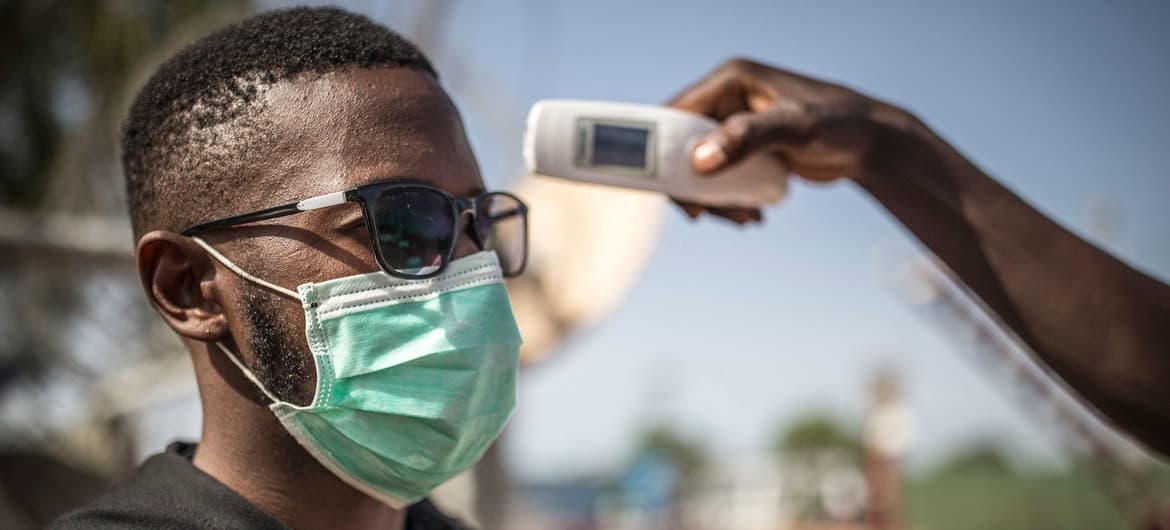
New COVID-19 variant with multiple mutations discovered in South Africa
On November 25, 2021, South African health officials announced the discovery of a new coronavirus variant that is causing concern due to its high number of mutations and rapid spread among young people. The variant, which has been designated B.1.1.529, has also been found in travelers from South Africa in Botswana and Hong Kong.
The World Health Organization (WHO) has said that the B.1.1.529 variant is a "variant of interest" and is monitoring it closely. The WHO has also said that it is too early to say whether the variant is more transmissible or deadly than other variants.
Scientists are still working to learn more about the B.1.1.529 variant, but here is what we know so far:
The variant has a high number of mutations, including more than 30 mutations to the spike protein. The spike protein is the part of the virus that binds to human cells, so mutations to this protein could make the virus more transmissible.
The variant is spreading rapidly among young people in Gauteng, South Africa's most populous province. This suggests that the variant may be more transmissible than other variants among this age group.
The variant has not yet been widely detected outside of South Africa, but it is possible that it is already circulating in other countries.
It is important to note that it is still too early to say whether the B.1.1.529 variant is a cause for serious concern. Scientists need more time to learn more about the variant, including its transmissibility, severity, and ability to evade vaccines.
In the meantime, it is important to continue to take steps to protect yourself from COVID-19, such as getting vaccinated and boosted, wearing a mask in public indoor settings, and social distancing.
What can the international community do?
The international community can play a role in helping to contain the spread of the B.1.1.529 variant by:
Providing financial and technical support to South Africa and other countries in the region to help them to scale up surveillance, testing, and contact tracing.
Ensuring that vaccines and other essential medical supplies are available to all countries, regardless of income level.
Promoting vaccine equity and vaccine uptake around the world.
Supporting international efforts to sequence the virus and track the spread of new variants.
Conclusion
The discovery of the B.1.1.529 variant is a reminder that the COVID-19 pandemic is not over. It is important to continue to take steps to protect yourself from COVID-19 and to support global efforts to contain the spread of the virus.
ANDREW MELDRUM AND MOGOMOTSI MAGOME/AP
Related Reporting
A Half-Year of Atrocities: The Human Rights Landscape in 2026
LONDON — The year 2026 arrived with no shortage of warnings. Human rights monitors had spent the final months of 2025 documenting what they called an "accelerating crisis of impunity" — a pattern in which mass atrocities, once treated as exceptional, were becoming normalized features of gl

The Second Tape Drop: When Corruption Touches Defense, Impunity Is No Longer an Option
KYIV — The first batch of recordings was embarrassing. The second is devastating.In late April and early May, Ukrainian journalists and anti-corruption activists released a torrent of audio files — hundreds of hours of conversations involving Timur Mindich, the businessman already at the center of t

The First Tape Drop: How the 'Mindich Tapes' Exposed a Hand-Managed Parliament and Cabinet
KYIV — They arrived without warning, as these things now do: audio files, compressed and anonymized, uploaded to a Telegram channel with a modest following and a reputation for publishing what Ukraine's mainstream outlets would not touch. The voices were clear enough. One belonged to Timur Mindich,